Cyborg Algorism
The manifesto-treatise: hybrid authorship, non-concealment, and the Jacquard loom as historiographic argument from Wiener's cybernetics to machine learning.
postalgorism.org — Patrick Lichty — media artist & theorist
Hybrid authorship, declared. Three decades of algorithmic practice — plotter, loom, and headset — continuing the algorist lineage into the era of machine collaboration.
// chaos: 0.100 → breathing
§ cyborg algorism / and after
The algorists drew with code. The cyborg algorist draws in concert with the machine — and says so.
Cyborg algorism names a practice of hybrid authorship: human intention and machine process bound in a single compositional system, with neither partner concealed. It extends the algorist tradition of Verostko, Molnár, and Hébert — artists who wrote their own instruments — into a moment when the instrument writes back. The framework's historiographic anchor is the Jacquard loom: the punched card that connects weaving to Wiener's cybernetics to contemporary machine learning is not a metaphor but a material genealogy, and the work returns to thread as often as it returns to code.
Its governing ethic is non-concealment. Where much AI-adjacent art trades on ambiguity about how the image was made, cyborg algorism treats the declaration of process — parameters, training material, the division of labor between hand and system — as constitutive of the work rather than a curatorial afterthought. The post in post/algorism marks the same continuity the algorists claimed for themselves: not a rupture with the hand, but the hand's extension through a system that must remain legible.
The author is a system. Human intention, written procedure, and machine contribution form one compositional agent; credit and responsibility are distributed, not dissolved.
Declare the process. Parameters, tools, and collaborations are stated in the work's documentation. Ambiguity about making is not mystique; it is a withheld fact.
The Jacquard card is the origin document. Weaving, cybernetics, and machine learning share one lineage of encoded pattern; the practice moves along it in both directions.
Intention leaves a remainder. What the statistical system cannot supply — the deviation, the parameter chosen against smoothness — is where authorship becomes visible.
plate 01 / the magic square
The magic square as a score to be traced — each permutation walked from one to twenty-five in a trembling hand.
Melancolia begins with the magic square in Dürer's engraving — the Renaissance's talisman against the melancholy of the maker, a cure encoded as mathematics, a pharmakon that is both the affliction of endless permutation and its remedy. The work treats the square not as an image but as a score: a field of numbered positions whose hidden order becomes visible only when it is traced.
Each motif constructs an order-five square by the Siamese method, then passes it through its own symmetry group — rotations, reflection, cyclic row and column shifts — so that every square in the array is a distinct permutation of the same invariant. The drawing then walks the square from one to twenty-five, connecting consecutive values with hand-drawn semicircular arcs at two percent disorder: Molnár's threshold of inhabitation applied to a path rather than a form. Crescents and scratch marks accumulate at the nodes like tool-marks on stone. What emerges is petroglyphic — the magic square rendered as the record of a hand tracing an order it cannot see whole, joining the combinatorial lineage of Queneau, Calvino, and Gysin to the rock-art inheritance of the Hajar traditions, one generation past Molnár's Hommage à Dürer, with the machine a declared collaborator in the permutation.

Drawn in-browser by the Molnar Magic Square Petroglyphs engine (Processing 4): each motif's square is generated by the Siamese method, randomized by rotation, reflection, and cyclic shift, then traced value-to-value in two-pass hand-drawn arcs with micro-breaks, crescents, and scratches at two percent disorder.
The arc-square returned to the loom: the same generative motif expressed in thread, where the weave itself becomes the last layer of disorder.
plate 02 / the apophatic sublime
City blocks as petroglyphs; XR as the cave wall; drawing at architectural scale toward a form the eye cannot fully hold.
The city works begin with a binary space partition: a field recursively divided into blocks, the blocks into windows, strips, and courtyards — an urban plan generated the way a city actually accretes, by subdivision. Rendered by plotter, the compositions read as plans for cities that do not exist; rendered in thread, as aerial maps woven at the resolution of the loom. The vocabulary reaches back through Verostko's scripted line to the Hajar petroglyph traditions: mark-making as a record of habitation, geometry as testimony.
In XR, the drawings become environments to be drawn inside — at Lascaux scale, in Lascaux conditions. Working under retinitis pigmentosa, the artist draws toward forms only partially visible, navigating by structure rather than sight. The project's theoretical frame names this the apophatic sublime: the tradition of the via negativa — Pseudo-Dionysius, Eckhart, The Cloud of Unknowing — joined to the algorist's asymptotic reach. Code and the hand are revealed as the same gesture: two ways of reaching for a form neither can fully grasp.
In VR the plans stop being plans. The two-dimensional partitions extrude into volumetric cityscapes: blocks rise as buildings, gutters open into streets, window grids become façades, and the composition that reads as an aerial drawing on paper becomes an environment entered and traversed at full architectural scale. And as with Melancolia, the works return to thread — the city compositions are also expressed as Jacquard weavings, the extruded metropolis flattened back into the loom's pixel grid, so that a single generative system exists simultaneously as drawing, habitable space, and textile.
Drawn in-browser by a direct port of the City-Block Petroglyphic Rectangular Arrays engine (Processing 4); super-blocks marked in ultramarine. XR documentation and plotter scans to be placed alongside.
plates 03–05 / the threshold itself
Molnár chose one percent of disorder. This work moves through the whole range — and makes the threshold the subject.
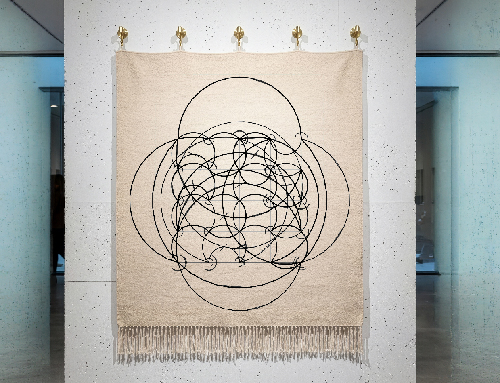
None of the circles is a circle. Each is a hundred short segments whose endpoints are displaced by a quantity proportional to the radius and to a single parameter: chaos. At ten percent, the outermost ring visibly trembles — the line wants to be a circle and keeps failing. At one percent, the failure is nearly imperceptible; the form almost closes. Molnár identified that one percent as the threshold where a structure stops reading as mechanical and starts reading as inhabited. This work refuses to choose a value. It moves through the field.
Each material register makes the argument differently. The plotter lays its own mechanical handwriting — pen drag, ink pooling — over the parametric noise. The Jacquard loom adds a third discretization: thread does not make circles, and at low chaos the weave itself becomes the approximation. The video breathes between the states in real time. A drawing at one percent and a drawing at ten are not the same statement at different intensities; they are positions in a field of formal possibility, visible only in relation to one another.
index / texts in and around the practice
Non-concealment extends to the page: the practice is documented as it is made.
Essays, papers, and chapters written alongside the work — theory as part of the production chain rather than commentary after the fact. Full texts and PDFs will be linked here as each is published.
The manifesto-treatise: hybrid authorship, non-concealment, and the Jacquard loom as historiographic argument from Wiener's cybernetics to machine learning.
The algorist lineage rethought for the era of machine collaboration — the formal journal statement of the framework.
Artist's essay on the magic-square works: Dürer, Molnár, the combinatorial line through Queneau, Calvino, Eco, and Gysin, and the square as pharmakon.
On the BSP city works: recursive subdivision as composition, the plotter's mechanical handwriting, and the urban plan as petroglyph.
Via negativa and the algorist's asymptotic reach: Pseudo-Dionysius, The Cloud of Unknowing, Lascaux, and drawing at XR scale under progressive vision loss.
On Molnár's un pour cent de désordre and the threshold works: what the parameter does across drawing, tapestry, and video.